House Poetics. An ‘assemblage’ approach to the production and transmission of value in Bronze Age Crete
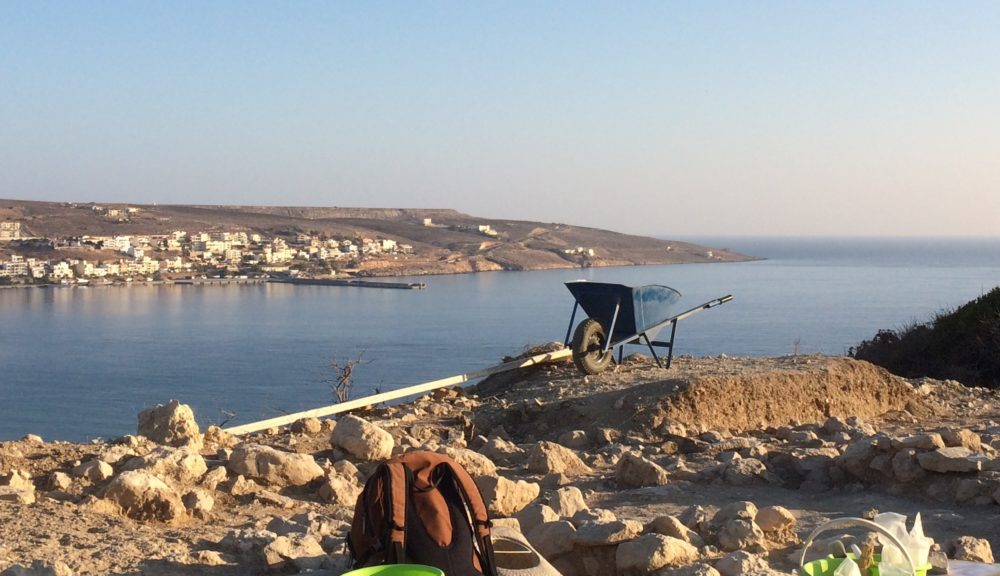
This EU funded project (H2020 Grant no: 752179) explores the fundamental social question of the creation of value, by investigating House societies in Bronze Age Crete (3100-1200 BC). Houses are understood as intergenerational, locus-bound social groups, holding an estate of material and symbolic wealth, transmitted along a real or imaginary line, legitimised by kinship or affinity, or both (Levi-Strauss 1982, 174). Because of their distinct focus on the creation and transmission of value, Houses are an ideal framework for exploring this question, but their longevity makes it difficult to explain change. By fusing Houses with the philosophical and sociological premises of assemblage theory, arguing that social entities are not fixed but constituted by relationships between humans, non-humans and materials that can territorialize and deterritorialize value (Deleuze & Guattari, 1987; De Landa 2006), the project aims to create a new social ontology which perceives Houses in a constant state of becoming, continuously affecting and being affected by the changing social world they inhabit. The methodological advantage of this interdisciplinary model, combining philosophical, sociological, archaeological and scientific perspectives, will be demonstrated empirically through the integrated use of GIS spatial analysis and material culture analysis, in a series of case studies (selected on the basis of availability of good contextual information for primary data and a large corpus of published evidence) targeting three strategic scales of House formation and interaction: a single site (Petras), its regional context (East Crete) and their broader geopolitical networks (the Aegean and the East Mediterranean). Using GIS to explore Houses as Assemblages will offer an original integration of spatial, material and social scales that can revitalize our understanding of past societies.
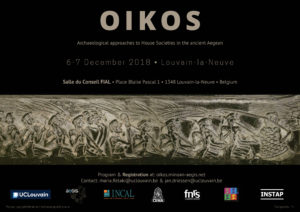 PROJECT UPDATE: As part of the House Poetics project we organise the following workshop at UClouvain this December. Participants have been confirmed and the programme has been published, abstracts to follow soon.
Registration is open at: https://oikos.minoan-aegis.net/home
OIKOS. Archaeological approaches to House Societies in the ancient AegeanInternational Workshop organised by AEGIS at the UCLouvain, Louvain-la-Neuve, 6th-7thDecember 2018
Conveners: M. Relaki & J. Driessen
Lévi-Strauss was the first to recognize the potential of Houses as “moral persons holding an estate made up of material and immaterial wealth which perpetuate themselves through the transmission of their name, fortune and titles down a real or imaginary line, considered legitimate as long as this continuity can express itself in the language of kinship or of affinity, and most often of both” for bridging kin-based and class-based social orders. The rigour of the model in illuminating the intersection between individual or small-scale social units and larger, collective structures from a diachronic perspective has generated a wealth of anthropological and archaeological scholarship in recent years. While the flexibility and diversity embodied in the model offer clear advantages for analysing ancient social practices, a lot of its features require greater critical scrutiny. We propose to approach Houses as heuristic devicesfor exploring social relations and modelling social interactions in the past, viewing the House society model as aninherently flexible set of structuring principlescapturing relations, behaviours and patterns that subvert traditional categories of social interaction. Houses are resolutely entangled with material culture and the world of things making them an interpretive model rooted in post-humanist and new materialist approaches; they can encompass and operationalise multiple spatial and temporal scales, without subsuming one to another in overarching hierarchical schemata; their material, social and political facets (e.g., combining hierarchical and heterarchical structures; being focused on collective representation whilst allowing for the emergence of individual identities; deploying architectural elaboration as both a method of unification and differentiation), allow for a more nuanced and sophisticated understanding of the past, which we think is worth exploring further. The geographical and cultural context of the ancient Aegean (broadly defined) offers a meaningful setting in which to situate these concerns, allowing us to follow up materialisations and expressions of Houses through time with reference to social processes and practices with transformative power and long-term implications.
The workshop aims to bring together a panel of international scholars to discuss, embellish, and debate the usefulness of the House Society model in the context of the ancient Aegean, and especially Minoan Crete, in any of the following fields of investigation (although by no means limited to these areas).
- House membership. Approaches that consider the constitution of Houses from a number of perspectives including: kinship, funerary behaviour, bioarchaeology, architecture/spatial patterning, gender dynamics, marriage patterns, population mobility.
- The role of Houses in political and economic organisation. How might collective action, alliance, co-operation, and integration affect the organisation of production, the allocation of resources; trade and exchange patterns; and administration?
- Material culture is a key component in the definition of Houses as social entities. Can the study of ancient technology and craft production be approached from a House Society perspective?
- Ritual and symbolic expressions of House identity; aspects of ancestor veneration, heirlooms; religion, cult.
- Diachronic perspectives: continuity and disruption in activities associated with Houses; conflict and violence; the configuration and transformation of territories; the shaping of physical and social landscapes.
Participants will have 25 minutes to present their paper, followed by 10 minutes for discussion. The language of the workshop is English. A critical aim of the conference is to stimulate debate, so discussion times are incorporated after each paper and at the end of each session. The conveners will present a general discussion at the end of the workshop to summarize the proceedings.
All submitted papers will be peer-reviewed by a scientific committee at UCLouvain and accepted manuscripts will be published in the Aegisseries of the Presses Universitaires de Louvain (https://pul.uclouvain.be/collections/aegis/). Publication is scheduled by the end of 2019.